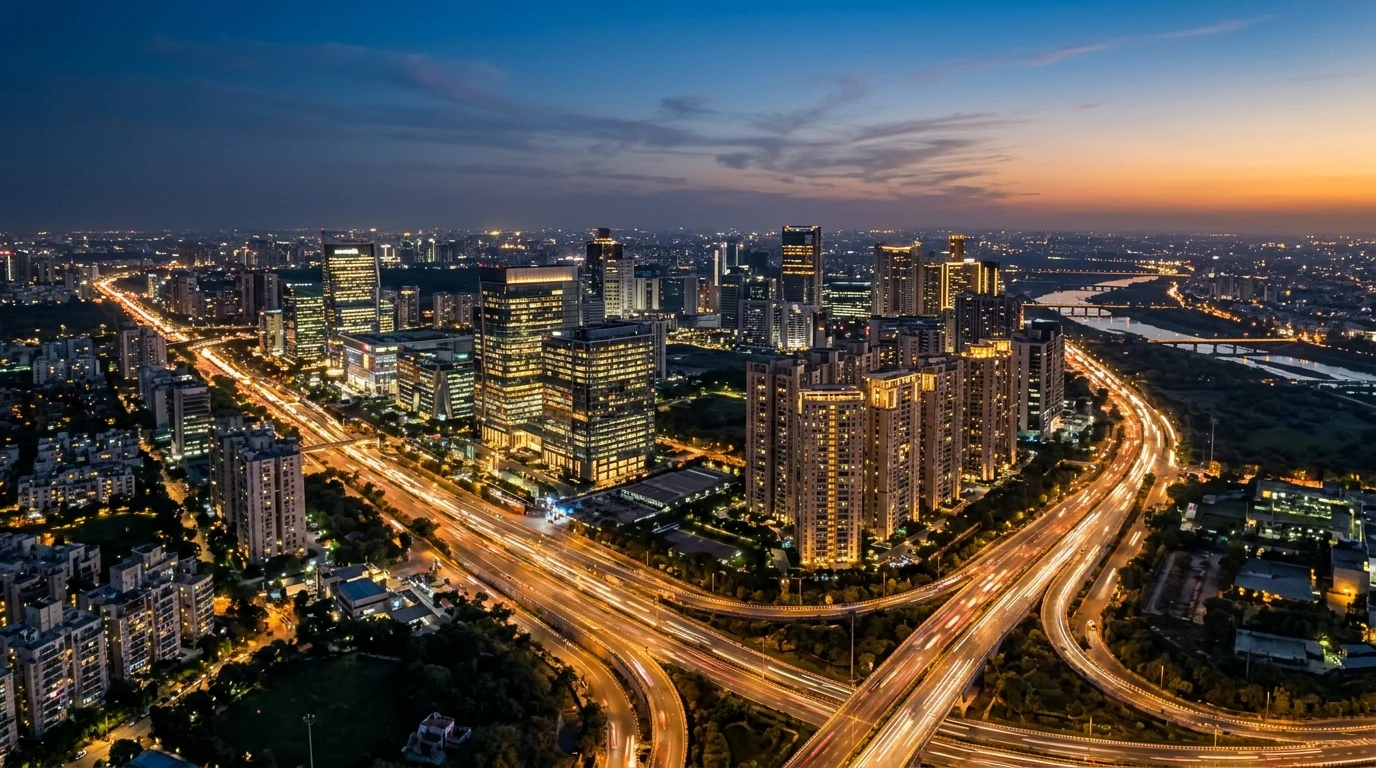
The debate between Noida and Gurugram has animated Delhi NCR real estate discussions for over two decades. Historically, Gurugram established itself as the preferred private enterprise citadel, attracting Fortune 500 headquarters, prestigious private developers, and ultra-luxury condominium pricing. Noida, meanwhile, was recognized for its superior master-planned road grid, government infrastructure discipline, and accessible land valuations.
In 2026, the landscape has fundamentally evolved. With commercial operations underway at Noida International Airport (Jewar), the Union Cabinet approval of the Sector 142–Botanical Garden Metro line, and an aggressive influx of Global Capability Centers (GCCs), the pricing spread between the two cities presents profound strategic questions for High-Net-Worth Individuals (HNWIs) and institutional family offices.
Rather than declaring one city an arbitrary "winner," this study disaggregates both markets into comparable micro-segments to guide balanced, objective asset allocation.
1. Comparing Comparable Micro-Markets, Not Uniform Cities
Treating entire metropolitan districts as uniform entities is the primary error in regional property analysis. A rigorous capital assessment must evaluate matched micro-market pairs:
Matched Corridor Comparison
- Ultra-Prime Luxury Residential: Golf Course Road & DLF Phase 5 (Gurugram) versus Sector 128 (Kalpataru Vista / ATS Knightsbridge) & Sector 150/151 (Noida Expressway).
- Emerging Growth Arteries: Dwarka Expressway & Southern Peripheral Road (Gurugram) versus the 165 km Yamuna Expressway Aerotropolis (Noida/YEIDA).
- Commercial Office & IT Campuses: Cyber City / Cyber Hub / Udyog Vihar (Gurugram) versus Sector 140A / Sector 142 (CRC The Flagship, Fairfox EON, ONYX by Splendor).
2. Entry Valuations Per Sq.Ft & Transaction Frictional Costs
The most stark divergence between the two markets lies in entry price points and acquisition friction:
| Parameter | Gurgaon (Prime Corridors) | Noida (Expressway & Sec 150) |
|---|---|---|
| Luxury Residential Rates | ₹22,000 - ₹45,000+ / sq.ft | ₹11,000 - ₹18,500 / sq.ft |
| Minimum Luxury Ticket Size | ₹7 Cr - ₹25 Cr+ (4,000+ sq.ft units) | ₹2.5 Cr - ₹7 Cr (Experion Saatori, CRC 150) |
| Grade-A Commercial Rates | ₹14,000 - ₹24,000 / sq.ft | ₹8,000 - ₹13,500 / sq.ft (CRC Flagship, EON) |
| Land Titling Structure | Freehold private developer licenses | Authority 90-yr Leasehold (Noida/YEIDA) |
| State Stamp Duty | 7% (Male) / 5% (Female) | 7% (Standard across UP) |
An investor with a ₹10 Crore capital allocation can acquire a single luxury apartment on Golf Course Extension Road, or acquire a diversified basket in Noida comprising a prime 4 BHK luxury home in Sector 150 plus two pre-leased commercial office suites in Sector 140A.
3. Commercial Leasing Demand & Rental Yield Realities
Both cities are major engines of corporate office absorption, but their yield profiles reflect their pricing stages:
- Gurgaon Corporate Core: Home to legacy BFSI, Fortune 500 regional headquarters, and major consulting practices. Because capital values in Cyber City and Golf Course Road have escalated dramatically, gross office yields have compressed to 6.8% to 7.8%.
- Noida Expressway IT Corridor: Expanding rapidly as technology majors, fintech enterprises, and GCCs seek modern Grade-A floorplates at competitive rentals (₹55 to ₹85/sq.ft vs ₹120 to ₹180/sq.ft in Gurgaon). Because capital entry prices remain lower, gross commercial yields range between 7.2% and 8.4%, offering higher cash-on-cash yield.
- Residential Rental Performance: In luxury residential condominiums, Gurgaon yields typically hover around 3.0% to 3.8%, while Noida luxury units yield between 3.2% and 4.2%, supported by intense executive rental demand from adjoining IT corridors.
4. Infrastructure: Master-Planning Discipline vs. Commercial Magnetism
Infrastructure quality defines long-term liveability and asset durability:
The Noida Urban Advantage: Statutory Town Planning
- Pre-Planned Sector Grid: Noida was conceived as an integrated statutory authority city. Underground power cables, centralized sewerage networks, and standardized 45m and 60m sector arterial roads eliminate the waterlogging and private-access road challenges seen in older private developer colonies.
- Green Cover Mandates: Sectors like 150 and 151 mandate up to 80% green coverage, ensuring that high-density overbuilding cannot erode ambient quality of life.
- Multi-Modal Transit Execution: Jewar Airport commenced commercial flights on 15 June 2026, and the Union Cabinet approved the 11.56 km Sector 142–Botanical Garden direct metro spur, providing direct rail connections into South Delhi.
The Gurgaon Magnetism: Proximity & Enterprise Ecosystem
- Indira Gandhi International (IGI) Airport: Proximity to Terminal 3 (15–30 minutes from Cyber City) remains Gurgaon's unbeatable advantage for frequent multinational flyers.
- Social & Lifestyle Infrastructure: World-class private hospitals (Medanta, Fortis), international IB schools, and premier luxury dining avenues (Cyber Hub, Horizon Centre) give Gurgaon a mature, sophisticated urban lifestyle.
5. Strategic Allocation Scenarios for High-Net-Worth Portfolios
How should an ultra-HNWI or family office deploy capital in 2026?
Scenario A: Capital Preservation & Trophy Hold
Recommended Allocation: Gurugram (Golf Course Road / DLF Phase 5)
Best suited for generational wealth seeking prestige trophy assets with global brand recognition, established expatriate rental pools, and established freehold liquidity, where yield percentage is secondary to peer prestige.
Scenario B: Growth Acceleration & Cash Flow Optimization
Recommended Allocation: Noida Expressway & Sector 150/151
Best suited for capital allocators seeking 1.5x to 2x appreciation velocity over a 5–7 year horizon, superior net cash-flow yields (7%+), and lower capital entry barriers backed by sovereign airport and metro infrastructure.
Frequently Asked Questions

Urban Investors Institutional Advisory Desk
Led by Manjit Choudhary and Mahendra Rai. Structuring large-ticket commercial portfolios or comparing luxury acquisitions across Noida and Gurugram? Connect with our directors.