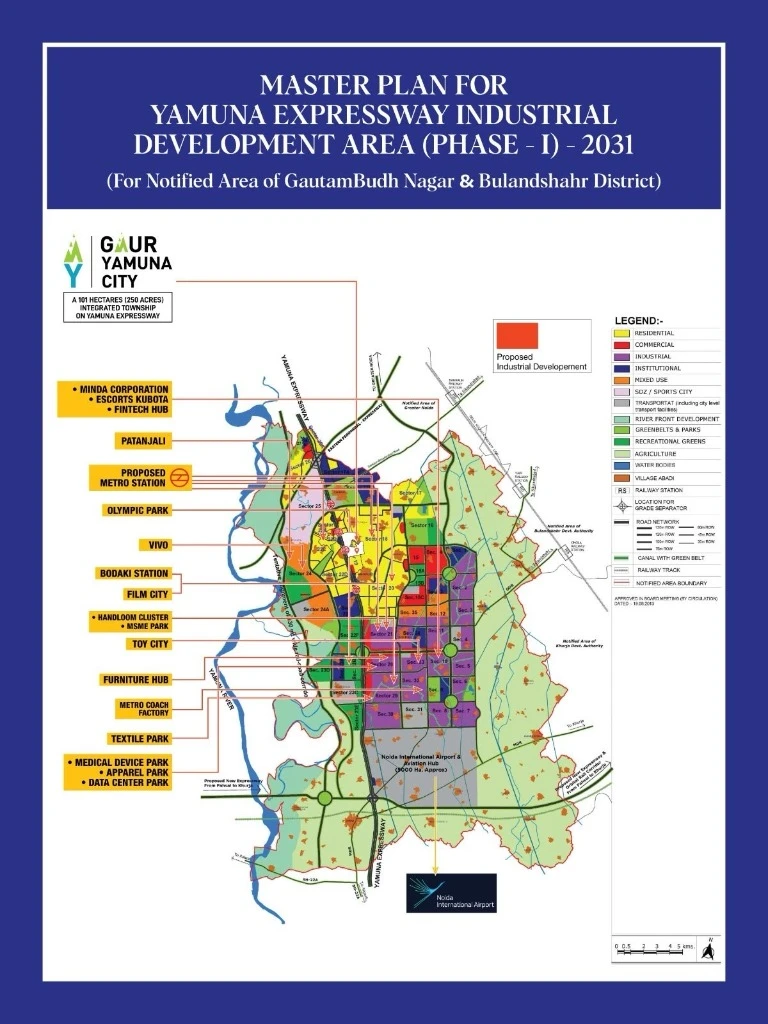
Figure 1: Official Master Plan for Yamuna Expressway Industrial Development Area (Phase - I) - 2031 (Notified Area of Gautam Budh Nagar & Bulandshahr District), approved in Board Meeting (by circulation) dated 19.06.2013. (Click image to view in high resolution).
Urban planning blueprints are often treated as marketing collateral by speculative property channels. However, for institutional investors, end-users, and analytical home buyers, statutory master plans serve a very different purpose: they outline the legal zoning, road right-of-ways, environmental buffers, and industrial clusters that will shape land valuation over decades.
Along the 165-kilometer Yamuna Expressway corridor connecting Greater Noida to Agra, the Yamuna Expressway Industrial Development Authority (YEIDA) is the statutory body responsible for regional town planning. The document depicted above—the Master Plan for Yamuna Expressway Industrial Development Area (Phase - I) - 2031—serves as the foundational zoning framework that established the initial residential sectors, manufacturing zones, and the Noida International Airport boundary.
In this research guide, the Urban Investors Research Advisory desk breaks down how the 2031 master plan was conceived, how it governs economic land use, how it compares to newer draft revisions (such as Master Plan 2041), and how property buyers should evaluate ground reality versus long-term authority blueprints.
Critical Planning Update: Master Plan 2031 vs. Master Plan 2041
The master plan map illustrated in this study represents Phase I — 2031, approved by the YEIDA Board on June 19, 2013. While this document established the foundational sector layouts (Sectors 17 through 33) currently being executed on the ground, YEIDA has since published a broader Phase I Draft Master Plan 2041. The 2041 framework expands the notified planning horizon across six districts, adds aerotropolis zoning around Jewar Airport, and plans for a regional population of several million. Property buyers should recognize the historical 2031 map as the bedrock of present sector allocations while referencing 2041 drafts for forward-looking infrastructure linkages.
1. Understanding the YEIDA Master Plan Framework
The Yamuna Expressway Industrial Development Authority was constituted in April 2001 under the Uttar Pradesh Industrial Area Development Act, 1976 (initially established as the Taj Expressway Authority). Its mandate is to execute planned industrial, institutional, residential, and commercial development along the Yamuna Expressway corridor across six districts: Gautam Budh Nagar, Bulandshahr, Aligarh, Hathras, Mathura, and Agra.
The Notified Area of Phase I (2031 Horizon)
Because the entire 165 km corridor spans over 2.6 lakh hectares, YEIDA divided its urban planning into distinct geographic phases. Phase I covers the northernmost urbanisable stretch of approximately 24,739 hectares located within the districts of Gautam Budh Nagar and Bulandshahr. This territory stretches from the southern periphery of Greater Noida (commencing near Pari Chowk) southward down to the boundary of the Noida International Airport at Jewar.
The Phase I Master Plan 2031 was prepared after extensive demographic projections, hydrological surveys of the Yamuna River floodplain, and industrial demand forecasting. Its formal approval on June 19, 2013 (by circulation of the YEIDA Board) established the legal zoning designations that still govern every sector numbering scheme from Sector 17 down to Sector 35.
How Planned Land Use Guides Regional Development
Unlike unplanned urban sprawl, master-planned corridors utilize strict land-use zoning to prevent conflicting activities. In the Phase I 2031 plan, land is segregated into distinct functional classifications:
- Residential Zones (Yellow): High-density and low-density residential sectors (e.g., Sector 18, Sector 20, Sector 22D) designed with mandatory internal green corridors, school sites, and local commercial complexes.
- Commercial Zones (Dark Red / Magenta): Regional commercial centers, high-street retail promenades, and mixed-use commercial ribbons running adjacent to the 100m Expressway service corridors.
- Industrial Zones (Violet / Purple): Non-polluting industrial sectors (Sectors 28, 29, 32, 33) reserved for electronics manufacturing, apparel, toy production, and logistics warehousing.
- Institutional Zones (Blue): Universities, professional colleges, technical training centers, and healthcare hubs (e.g., Sector 17A and 22A).
- Recreational Greens & Greenbelts (Green): Ecological buffers along the Yamuna riverfront, canal alignments, and sector boundaries, guaranteeing open space reservations.
- Special Development Zones (SDZ) & Sports City (Orange): Large-format integrated sport tourism enclaves, including the Buddh International Circuit (F1 track) and dedicated sports cities.
Primary Official Authority References
Buyers and researchers should always verify land allocations directly against official regulatory sources rather than secondary promotional literature:
2. Industrial & Employment Development: The Real Economic Engine
A fundamental tenet of sustainable urbanism is that residential communities cannot thrive in an economic vacuum. The long-term vitality of any real estate corridor depends on its ability to generate high-quality manufacturing, logistics, and corporate employment.
In the Phase I 2031 Master Plan, industrial land use occupies a substantial share of total developable area, intentionally positioned along major logistics arteries such as the Yamuna Expressway and the Eastern Peripheral Expressway (EPE). The plan demarcates dedicated manufacturing and industrial clusters designed to attract both domestic MSMEs and multinational corporations.
Key Industrial Clusters Highlighted on the Master Plan
Examining the spatial annotations on the 2031 map reveals a deliberate strategy of industry clustering:
- Medical Devices Park (Sector 28): A 350-acre flagship project under the Government of India's national medical devices promotion scheme, focused on medical consumables, imaging equipment, and diagnostic manufacturing.
- Apparel Park & Textile Hub (Sector 29): Allotted to garment manufacturing export units and textile processors to leverage regional cotton supply chains and air-cargo access.
- MSME & Toy City Parks (Sector 33): Designed to decentralize toy and precision manufacturing from unorganized hubs into state-of-the-art industrial layouts.
- Data Center Parks & Electronics Manufacturing (Sector 28 & 29): Hyperscale data center parks benefiting from high-capacity electrical sub-stations and optical fiber corridors along the expressway.
- Patanjali Food & Herbal Park (Sector 24 & 24A): A mega food processing and distribution facility covering over 300 acres, driving agricultural supply-chain employment.
- Major Industrial Campuses: Anchor manufacturing presences such as Vivo mobile manufacturing campus, Minda Corporation, and Escorts Kubota agri-machinery hubs.
Planned vs. Ground Reality: Distinguishing Status
When evaluating master plans, prospective buyers must separate allotted and operational facilities from under-construction or proposed concepts. The following table provides an objective breakdown of key employment nodes along the corridor:
| Cluster / Entity | Zoned Sector | Planned Activity | Current Ground Status |
|---|---|---|---|
| Patanjali Food Park | Sector 24 / 24A | Food processing & herbal manufacturing | Operational / Active Phases |
| Vivo Mobile Campus | Sector 24 | Smartphone assembly & components | Operational / Expanding |
| Medical Device Park | Sector 28 | Diagnostic & biomedical manufacturing | Under Civil Construction / Allotments |
| Apparel & MSME Hubs | Sector 29 & 33 | Garment export, toy manufacturing | Plots Allotted / Units Under Construction |
| Data Center Parks | Sector 28 | Hyperscale cloud data infrastructure | Land Handover & Structural Work |
| Fintech Hub | Sector 20 Periphery | Financial technology corporate offices | Planning & Policy Framework Stage |
| Metro Coach Factory | Near Sector 32 / Rail Corridor | Rolling stock manufacturing facility | Long-Range Proposed Reservation |
How Jobs Influence Housing Demand
The influx of blue-collar, technical, and executive personnel into these industrial zones directly stimulates regional housing absorption. However, this occurs in cycles:
- Initial Construction Phase: Migrant workforce with minimal demand for permanent residential housing; temporary labor colonies.
- Factory Commissioning Phase: Line supervisors, technicians, and quality inspectors seek affordable rental accommodation in immediate proximity (typically within a 10-15 km radius, such as Sector 22D and Greater Noida).
- Corporate & R&D Phase: Engineering directors, CXOs, and supply-chain partners generate demand for gated township residences and serviced studio suites.
Understanding this sequence prevents buyers from expecting immediate premium rental yields on day one; residential absorption steadily follows industrial maturity rather than preceding it.
3. Airport & Regional Transport Connectivity
Transport infrastructure is the skeletal framework upon which the entire Phase I Master Plan hangs. The 2031 map illustrates a multi-tiered circulation network designed to handle both heavy industrial freight and rapid passenger transit.
The Anchor: Noida International Airport & Aviation Hub
Anchoring the southern boundary of the Phase I urbanisable area is the Noida International Airport (Jewar), occupying approximately 3,000 hectares in its comprehensive master allocation. The 2031 plan laid out the initial boundary reservation for this mega-aerotropolis.
The presence of a greenfield international aviation hub transforms the adjoining sectors from peripheral suburbs into international gateways. Key planned linkages include:
- Air Cargo Terminals: Dedicated air cargo zones connected directly to industrial sectors via 100m wide secondary arterial corridors.
- Maintenance, Repair & Overhaul (MRO): Dedicated aviation engineering zones creating skilled aviation jobs.
- Aero-Hospitality & Convention Centers: Transit hotels, exhibition arenas, and business centers planned along the airport approach perimeter.
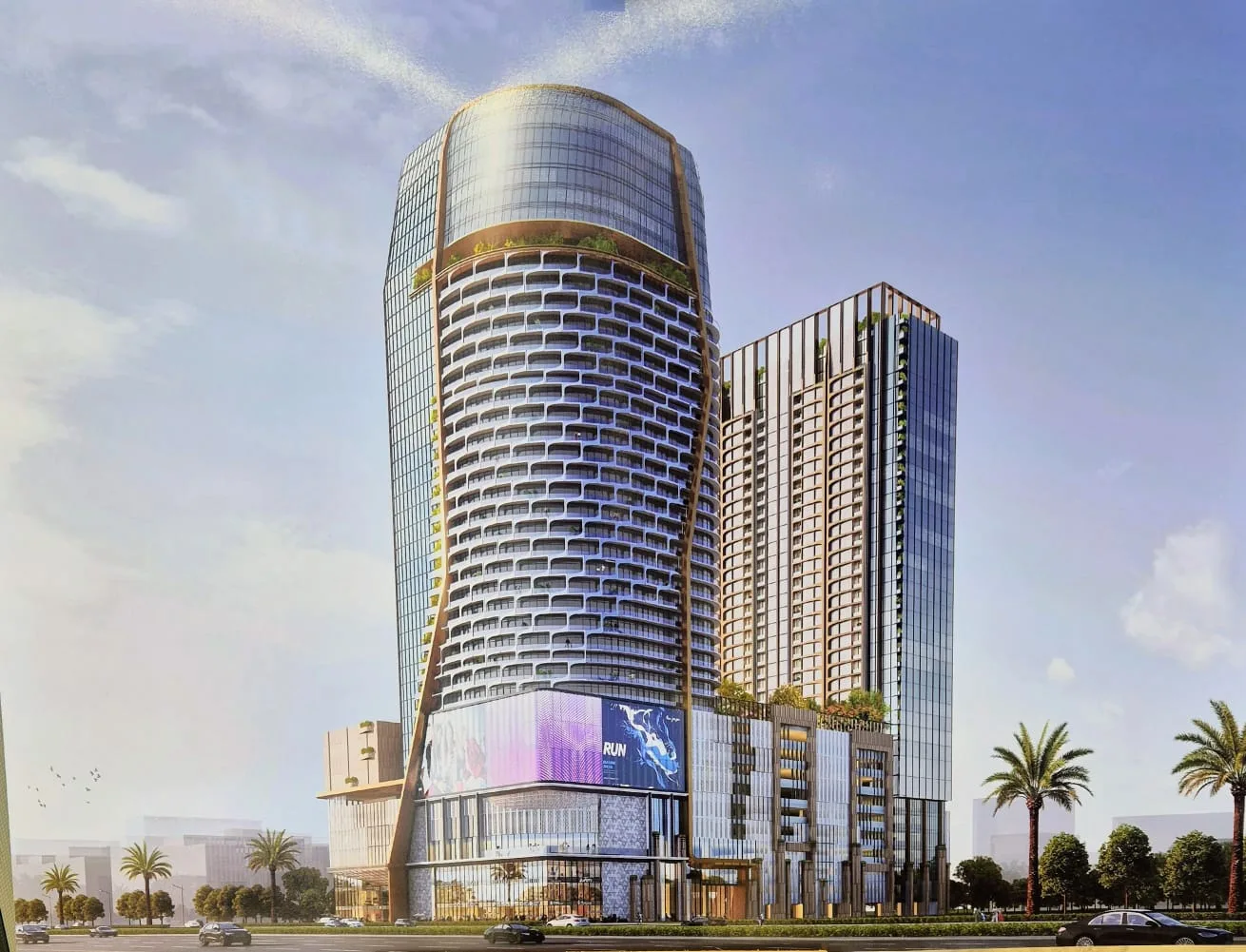
Modern commercial and serviced studio developments rising along the expressway corridor.

Approved residential township developments in Sector 22D, Yamuna Expressway.
Road Infrastructure: Operational vs. Proposed
A major strength of the Yamuna Expressway region is that its principal road spines are already functional:
- Yamuna Expressway (Operational): The 6-lane access-controlled highway (expandable to 8 lanes) serves as the primary regional spine with a 100-meter Right of Way (ROW) and 25-meter green buffers on either side.
- Eastern Peripheral Expressway (EPE / NE-II - Operational): Intersects the Yamuna Expressway near Sector 32, allowing freight to bypass Delhi entirely while linking Sonipat, Ghaziabad, Palwal, and the Delhi-Mumbai Expressway.
- Palwal-Khurja Link Expressway (Proposed): Earmarked to provide direct east-west connectivity between Haryana and Western UP across the southern boundary of the planning area.
- Internal Sector Grid: Standardized 60-meter, 45-meter, and 30-meter wide sector roads forming a rectangular grid designed for high vehicular throughput.
Mass Transit & Rail Corridors
Public transit links are essential to prevent expressway traffic bottlenecks. The master plan and subsequent planning authorities have designated multiple mass-transit corridors:
- Bodaki Multi-Modal Transport Hub (MMTH): Located in Greater Noida, connecting railway, interstate bus terminals, and the Aqua Line metro.
- Noida International Airport Metro Link (Sanctioned / Under Planning): A proposed high-speed metro link connecting Jewar Airport directly with Greater Noida (Knowledge Park II) and the Delhi Metro Airport Express network.
- Personal Rapid Transit (PRT) / Pod Taxi (Proposed): India's first proposed PRT pod taxi system designed to connect Jewar Airport directly with the International Film City across Sector 21.
4. What It Means for Property Buyers: Due Diligence Beyond the Map
Master plan maps look pristine and comprehensive on paper. Every sector appears perfectly gridded, parks look lush, and transit stations appear imminent. However, real estate investors who purchase purely based on a master plan map without rigorous on-ground due diligence risk facing extended holding periods, missing physical access roads, or unfulfilled infrastructure promises.
Here is how analytical property buyers should evaluate residential and commercial projects along the Yamuna Expressway:
1. Verify Approved Land Use & Zonal Clearances
Never assume that every parcel of land along the expressway is approved for residential housing. Check whether the project sits on land formally acquired and allotted by YEIDA for residential group housing or mixed-use commercial development. Beware of unapproved private subdivisions or unauthorized farm plots carved out of Village Abadi or Agricultural Green zones, which carry severe legal risk and demolition notices from the authority.
2. Assess Physical Access Roads (ROW vs. Ground Reality)
A project might boast frontage on a planned 60-meter arterial sector road on the master plan, but what exists on the ground today? If that 60-meter road has not yet been acquired or constructed by the authority, your property may currently be accessible only via narrow 3-meter rural village lanes. Verify the exact status of approach road construction and drainage networks before committing capital.
3. Review Surrounding Development & Civic Utilities
A residential tower cannot be occupied without drinking water pipelines, sewage treatment connections, and reliable electricity substations (UPPCL). Evaluate whether the surrounding sector has functional 33/11 kV substations, street lighting, and operational civic maintenance. Integrated townships such as Gaur Yamuna City (Sector 19 & 22) have developed internal utility substations, schools, and commercial convenience centers to mitigate peripheral infrastructure delays.
4. Investigate Developer Financial Standing & Authority Land Dues
Historically in Uttar Pradesh, multiple private developers defaulted on their installment payments to the local authorities, leading to delayed sub-lease deed registries for apartment owners. Before booking:
- Confirm that the project is registered with Uttar Pradesh RERA (UP RERA) and review its registered completion deadline and quarterly financial disclosures.
- Verify that the builder has cleared land dues with YEIDA or is compliant with the government's legacy stalled project relief policies (such as the Amitabh Kant Committee recommendations).
- Assess whether the developer has an active escrow account where 70% of buyer receivables are strictly reserved for construction.
5. Calculate the Total Cost of Acquisition
The basic sale price (BSP) quoted in brochures rarely represents the true acquisition outflow. When modeling returns on Yamuna Expressway assets, factor in:
- Preferential Location Charges (PLC): Expressway-facing, park-facing, or corner units often attract 5% to 15% premiums.
- Lease Rent & Infrastructure Development Charges (IDC/EDC): In UP, authorities levy one-time or annual lease rents that developers pass on to purchasers.
- GST & Registration Costs: 5% GST on non-affordable under-construction units, plus 7% UP stamp duty upon execution of the sub-lease registry.
- Holding Horizon: Real estate in greenfield corridors requires an investment horizon of 5 to 8 years. Investors expecting overnight liquidity or speculative flipping within 12 months often face high transaction friction.
Key Compliant Developments in the Influence Zone
For buyers seeking professionally managed, legally cleared inventory along the Yamuna Expressway, several prominent developments stand out:
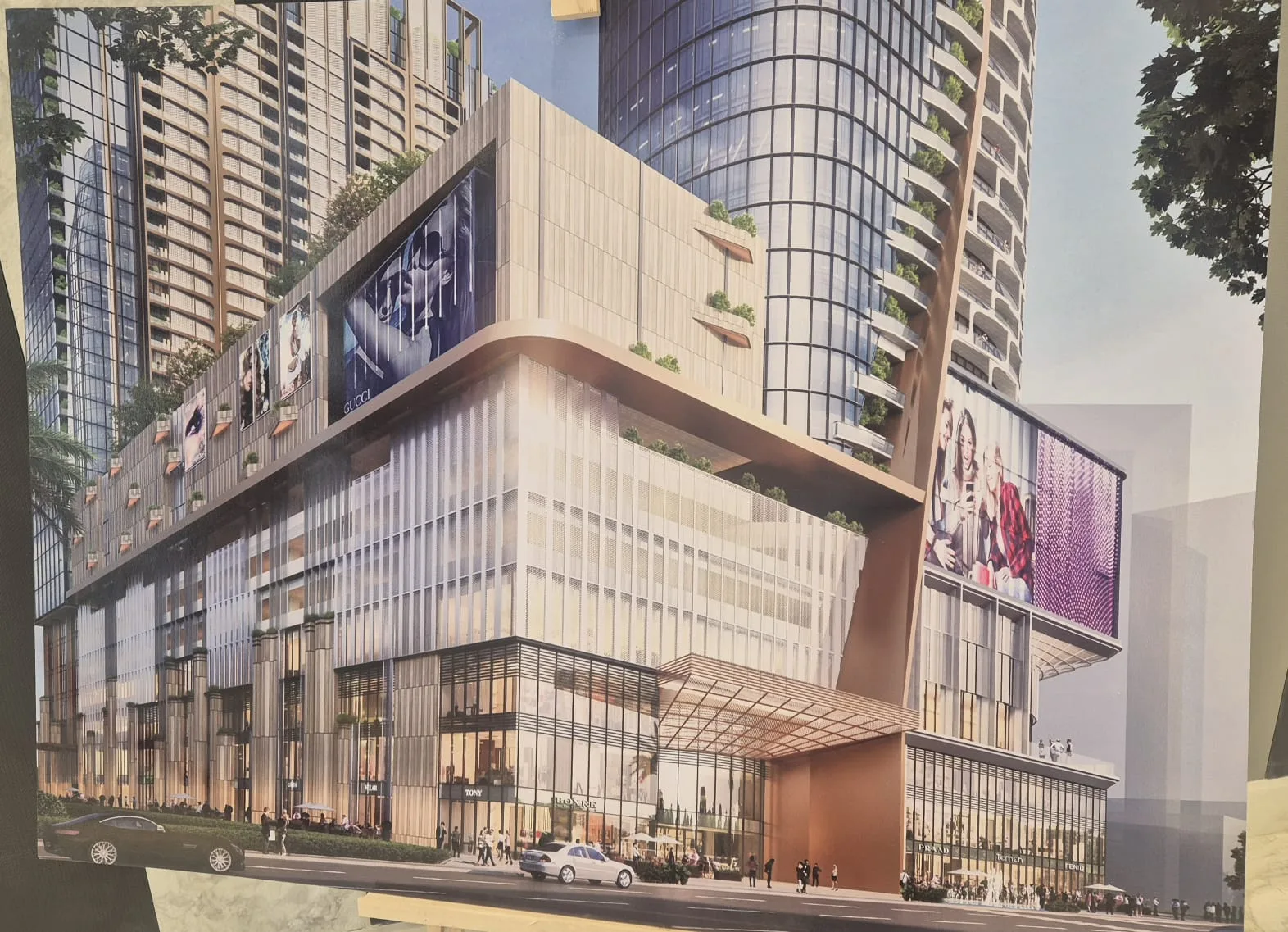
Gaur Bento (Studio Apartments)
Situated inside the 250-acre integrated Gaur Yamuna City township right on the Yamuna Expressway, Gaur Bento offers fully furnished serviced studio units tailored for aviation professionals, tech consultants, and corporate visitors.
- Location: Yamuna Expressway, Gaur Yamuna City
- Configuration: Fully Furnished Serviced Studio Suites
- Starting Price: From ₹77 Lacs*
- Strategic Advantage: Ready township ecosystem with operational retail, school, and direct expressway access.

Eldeco Whispers of Wonder
Located in Sector 22D, this gated residential enclave by Eldeco features premium 3 and 4 BHK air-conditioned apartments designed for families seeking high-quality construction and serene green surroundings.
- Location: Sector 22D, Yamuna Expressway
- Configuration: Premium 3 & 4 BHK Residences
- Starting Price: From ₹1.05 Cr*
- Strategic Advantage: Backed by Eldeco's 45-year delivery track record and debt-free execution.
Additionally, residential options like Gaur Chrysalis and Gaur Alaris represent high-rise township living within the same master-planned cluster, offering access to operational sports infrastructure, clubhouses, and central green parks. For an analytical review of historical capital appreciation rates across the corridor, explore our comprehensive Yamuna Expressway Investment Guide.
5. Evolution of Planning: Master Plan 2031 vs. Master Plan 2041
Regional urban planning is iterative. As the Noida International Airport evolved from a single-runway regional proposal into a multi-phase global aerotropolis, YEIDA recognized that the original 2031 boundaries needed substantial expansion. The following comparative table highlights the key strategic differences between the Phase I 2031 plan and the forward-looking 2041 Master Plan:
| Planning Dimension | Master Plan 2031 (Phase I) | Draft Master Plan 2041 |
|---|---|---|
| Approval Date | June 19, 2013 (Board Approval) | Draft Formulated / Progressively Notified |
| Geographic Scope | Upper corridor: Gautam Budh Nagar & Bulandshahr (~24,739 Ha) | Entire notified region across 6 districts (~5.8 lakh Ha) |
| Airport Integration | Initial land reservation for proposed civil aviation hub | Integrated Aerotropolis, Aero-City, and Logistics Park zoning |
| Sports & Entertainment | Buddh F1 Circuit & generic sports city designations | Dedicated Olympic City, Film City (Sector 21), and Heritage Cities |
| Target Population | Approx. 1.2 to 1.5 Million residents | Over 4.1 Million residents projected by 2041 |
| Transit Prioritization | Expressway road spine & basic rail reservations | High-speed metro spur, PRT pod taxi network, and multi-modal freight hubs |
Summary: A Research-Based Conclusion
The YEIDA Master Plan 2031 (Phase I) is neither a guarantee of overnight real estate riches nor an empty bureaucratic diagram. It is a legally binding urban blueprint that has successfully guided the establishment of India's most ambitious industrial and aviation corridor.
For property buyers, success along the Yamuna Expressway requires looking past superficial marketing hype and focusing on verified structural fundamentals: statutory land use clearance, developer financial solvency, active RERA registration, and physical infrastructure connectivity. As industrial manufacturing clusters come online and Noida International Airport approaches operational milestones, well-chosen assets in legally compliant master-planned sectors will continue to reward patient, research-oriented investors.
Frequently Asked Questions

Urban Investors Regional Planning & Advisory Desk
Authored by our institutional infrastructure research desk led by Manjit Choudhary and Mahendra Rai. Seeking verified RERA inventory, land title verification, or master plan consultations along the Yamuna Expressway? Schedule a confidential consultation.