Commercial real estate along the Noida-Greater Noida Expressway is experiencing a structural boom driven by Global Capability Centers (GCCs), technology corporations, and affluent residential catchments. However, when private wealth allocators and retail investors look at the commercial market, they frequently encounter an essential question: Should capital be allocated toward Grade-A corporate office suites or lockable high-street retail shops?
In retail broker brochures, both asset classes are frequently touted with generic "8% to 11% assured return" claims. In real estate investment, blanket yield figures without clarifying gross vs. net cash flow or factoring in vacancy cycles can be deeply misleading.
In this advisory guide, the Urban Investors Commercial Research Desk evaluates the micro-market dynamics of Sector 140A—anchored by institutional complexes like CRC The Flagship and Fairfox EON—to help investors analyze real income profiles, lease commitments, and exit liquidity.
The Yield Discipline: Gross Yield vs. Net Yield
Gross Rental Yield measures annual contracted rent divided by the basic purchase price. In Noida, Grade-A IT offices typically trade at gross yields of 6.5% to 8.5%, while premium ground-floor retail shops trade at 7.0% to 9.0%. However, Net Yield accounts for total all-in acquisition costs (BSP + PLC + IDC/EDC + GST + Stamp Duty) and deducts non-recoverable CAM charges, property tax, insurance, property management fees, and an annualized vacancy reserve. Prudent investors model a realistic net yield of 5.2% to 6.8%.
1. Grade-A Corporate Office Spaces: Stability & Institutional Tenancy
Sector 140A has evolved into Noida Expressway’s primary IT/ITES hub, positioned strategically at the intersection of the expressway and the Faridabad-Noida-Ghaziabad (FNG) corridor.
Lease Structures & Tenant Profile
Office tenants in Grade-A IT parks are typically institutional: IT service providers, fintech companies, MNC research laboratories, and domestic corporate headquarters.
- Long-Term Lease Contracts: Institutional corporate leases are structured under 9-year agreements (3+3+3 structure) with 3 to 5-year initial lock-in clauses.
- Predictable Escalations: Built-in rent escalations of 12% to 15% every 3 years ensure income keeps pace with inflation.
- Tenant Capex Stickiness: Corporate tenants invest ₹1,200 to ₹3,000 per sq.ft in specialized interior fit-outs, conference infrastructure, and server rooms. Because relocation is capital-intensive, corporate office tenants have high renewal rates.
Current Leasing Dynamics: CRC The Flagship & Fairfox EON
In projects like CRC The Flagship and Fairfox EON, developers have implemented unified institutional leasing desks. This prevents individual unit owners from undercutting each other on rent, preserving building grade and tenant quality. Pre-leased inventories with established corporate covenants trade at tighter yields (6.5% to 7.2%), while bare-shell lockable units allow investors to target higher initial yields (7.5% to 8.2%) upon fit-out completion.
2. High-Street Retail: Footfall, Visibility & Operating Risks
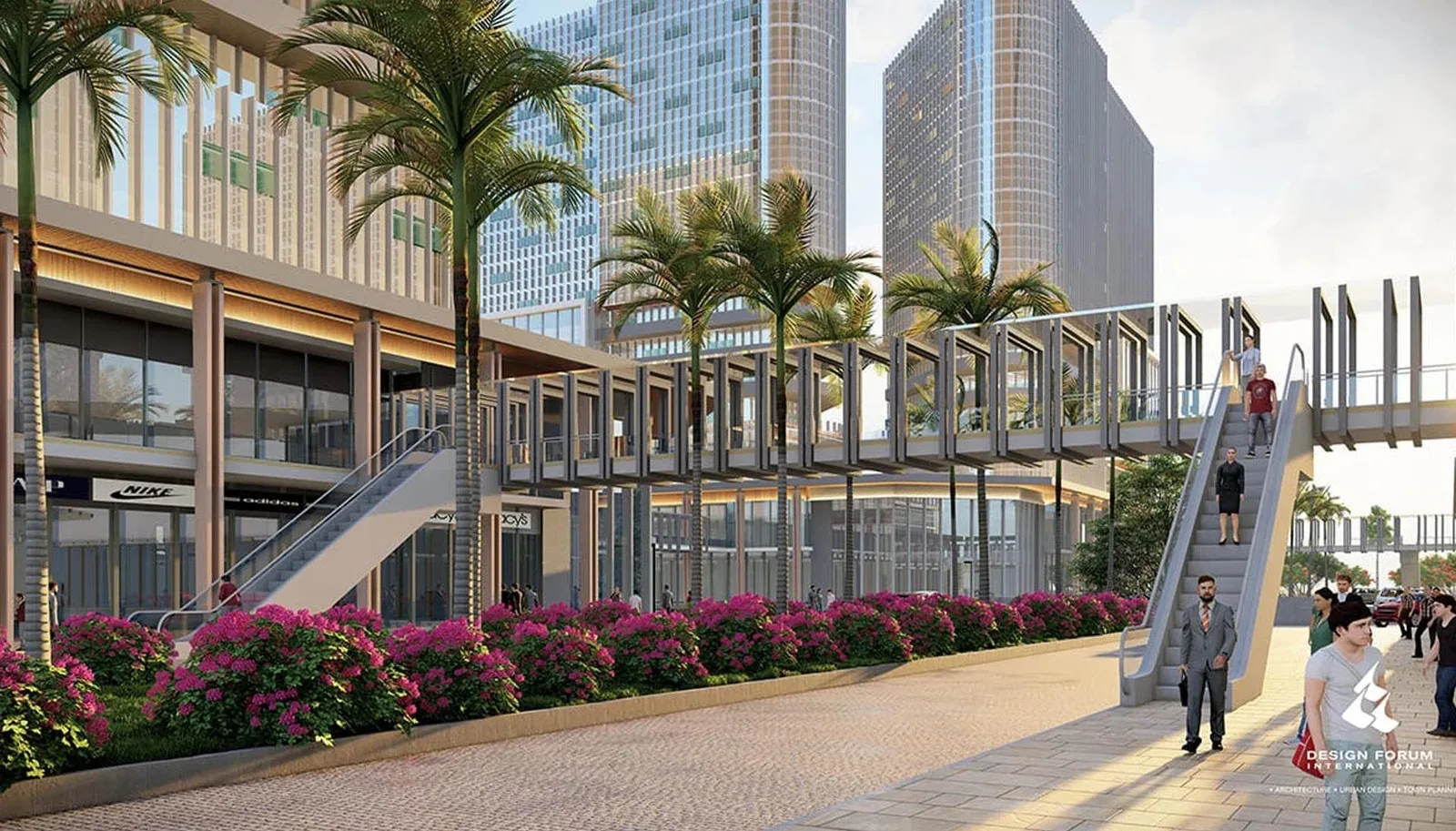
High-street retail assets in integrated commercial parks differ substantially from traditional shopping mall units. They feature open-air, double-height, wide-frontage shops lining landscaped pedestrian promenades, food courts, and anchor supermarkets.
The Footfall & Frontage Engine
Retail value is governed entirely by consumer footfall and road visibility:
- Daytime Captive Audience: In Sector 140A, retail shops capture a built-in captive customer base of tens of thousands of corporate employees working in the office towers above.
- Weekend & Evening Traffic: Surrounded by densely populated residential sectors (Sector 137, Sector 143, and Sector 144), high-street boulevards draw family footfall for F&B dining, cafes, salon services, and daily essentials.
- Frontage Premium: Ground-floor corner units with direct visual exposure to 45m arterial roads command 30% to 50% rental premiums over upper-floor courtyard units.
Retail Operating & Vacancy Risks
While high-street retail can achieve higher headline yields (8.0% to 9.0%), investors must account for operational friction:
- Shorter Lease Tenures: Retail tenants typically negotiate 3 to 5-year leases with 1 to 2-year lock-in periods. Tenant turnover in fashion and standalone eateries is significantly higher than in corporate offices.
- Extended Fit-Out & Rent-Free Windows: When a retail tenant exits, replacing them often requires 2 to 4 months of marketing vacancy plus a 30 to 60-day rent-free fit-out period for the incoming brand.
- Zoning & Utility Constraints: F&B units require specialized heavy electrical load sanctions, kitchen exhaust ducts, and plumbing drainage. Units lacking proper services face a restricted tenant pool.
3. Comparative Matrix: Office Suites vs. High-Street Retail
| Investment Metric | Grade-A Office Spaces (Sector 140A) | High-Street Retail Boulevard |
|---|---|---|
| Entry Ticket Size | ₹45 Lacs - ₹1.5 Cr (500 - 1,500 sq.ft) | ₹65 Lacs - ₹3.5 Cr (300 - 1,200 sq.ft) |
| Gross Rental Yield | 6.5% - 8.2% per annum | 7.0% - 9.0% per annum |
| Net Realized Yield | 5.2% - 6.5% (post taxes, maintenance) | 5.5% - 6.8% (factoring vacancy cycles) |
| Lease Duration | 9 Years (3+3+3) with 3-yr lock-in | 3 to 5 Years with 1-yr lock-in |
| Fit-out Responsibility | Mostly tenant-financed / bare-shell | Brand-specific fit-out / vanilla shell |
| Vacancy Risk | Low to Moderate (institutional stickiness) | Moderate to High (cyclical footfall) |
| Exit Liquidity | High if pre-leased with MNC tenant | High for ground-floor visible frontage |
4. Real ROI Modeling: The Acquisition Cost Formula
When evaluating a commercial purchase, calculating ROI based solely on the basic sales price (BSP) inflates projected yields by 1.5% to 2.5%. A comprehensive investment model must use the Total Cost of Acquisition (TCA):
For example, a commercial shop quoted at a basic price of ₹1 Crore will realistically require an all-inclusive outlay of approximately ₹1.24 to ₹1.28 Crore. If that shop leases for ₹80,000 per month (₹9.6 Lacs annually), the headline yield appears to be 9.6% on BSP, but the real gross yield on total acquisition cost is 7.5%. After factoring in 1 month of vacancy reserve, property taxes, and asset management fees, the true net yield is approximately 6.2%.
5. Exit Liquidity & Strategic Verdict
How quickly can you liquidate your commercial investment if you need capital?
- Pre-Leased Office Units: Highest secondary liquidity. Institutional family offices and HNIs actively seek operational office units leased to Grade-A corporate tenants with active lock-in periods, treating them as high-yield bond substitutes.
- Ground-Floor High-Street Retail: Strong liquidity among local business owners, doctors, and retail franchisees seeking operational frontage. However, upper-floor or interior-facing retail shops suffer lower secondary demand and longer selling cycles.
Urban Investors Advisory Verdict
If your investment goal is stable, hands-off passive income with institutional tenant covenants, allocate capital toward Grade-A office suites in integrated hubs like Sector 140A (CRC The Flagship or ONYX by Splendor).
If your goal is higher cash-flow upside, consumer-facing visibility, and personal business utility, select ground-floor retail shops with primary road frontage in high-density corridors like Fairfox EON or Grandthum, while maintaining a dedicated 3-month rental buffer for tenant transitions.
Frequently Asked Questions

Urban Investors Commercial Advisory Desk
Authored by our institutional commercial leasing and asset evaluation desk. Evaluating lockable offices or high-street retail shops in Sector 140A, Sector 142, or Greater Noida West? Schedule a confidential yield audit.